A sudden push-off during running, badminton, football, tennis, or another explosive activity can sometimes be followed by a sensation that someone has kicked the back of the ankle. When no one is actually behind you, an Achilles tendon rupture becomes an important possibility.
A Tendoachilles tear can significantly affect walking and sporting performance because the Achilles tendon transfers force from the calf muscles to the heel.
Recognising a Possible Achilles Tear
Typical symptoms can include a sudden snap or pop, pain at the back of the ankle, swelling, weakness during push-off, and difficulty standing on the toes of the affected leg.
Interestingly, severe pain does not always persist. Some patients can still walk after a rupture, although their gait may be abnormal.
This can lead people to mistake the injury for an ankle sprain.
Early Assessment Can Clarify the Injury
Clinical examination is central to diagnosis. Ultrasound or MRI may be used in selected cases to assess the tendon and injury characteristics.
The clinician may evaluate:
- Whether the tear is complete or partial
- The location of the rupture
- Tendon gap
- Time since injury
- Skin condition
- Functional requirements
- Sporting level
- General health
These factors can influence treatment planning.
Does Every Tendoachilles Tear Need Surgery?
No.
Both operative and carefully supervised non-operative treatment can be considered for Achilles tendon ruptures in appropriate patients.
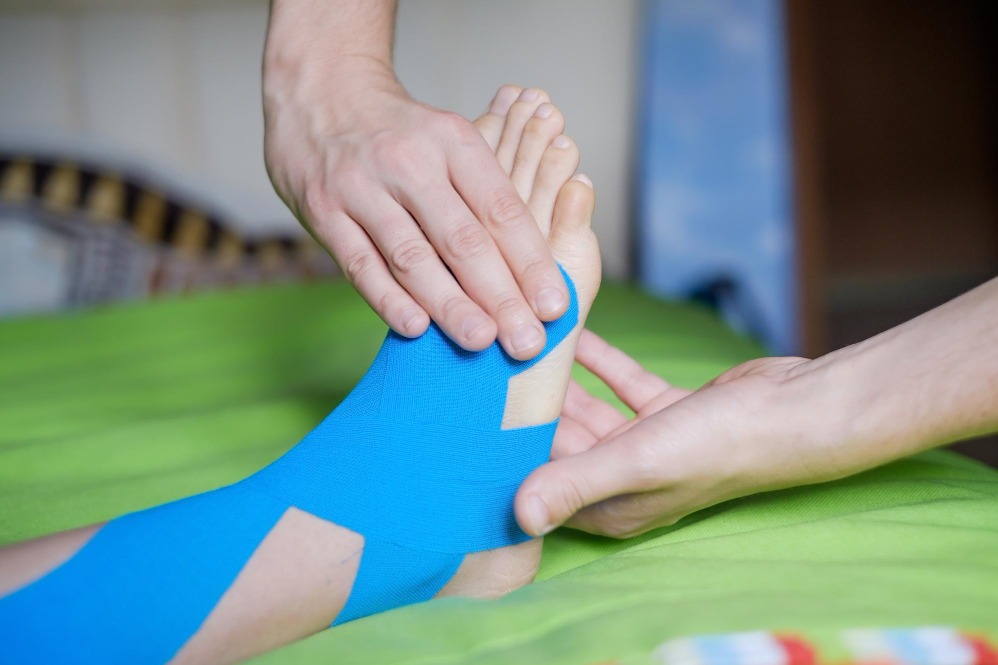
Modern non-operative protocols can involve functional bracing followed by controlled progression of movement and weight bearing. Surgery may be considered based on the injury characteristics, patient profile, activity requirements, timing, and expected demands on the tendon.
The choice should therefore be individualised rather than based on the assumption that every athlete must have surgery.
What Does Recovery Involve?
Regardless of treatment route, rehabilitation is essential.
The tendon initially requires protection in a position that allows the torn ends to heal appropriately. Over time, movement and loading are progressively introduced.
Later rehabilitation focuses on calf strength, ankle control, walking mechanics, balance, and eventually running or sport-specific activity.
Calf strength can take considerable time to rebuild.
Avoid Testing the Tendon Too Early
Patients sometimes repeatedly try to stand on their toes to see whether the tendon has recovered. Aggressive self-testing early in rehabilitation is not advisable.
Healing tissue needs progressively controlled loading.
Return to running should occur only after sufficient strength and functional control have developed. Explosive sports require even more preparation because sprinting, jumping, and rapid directional changes create substantial Achilles loads.
What to Look for in a Treatment Provider
For an active patient, evaluation should go beyond confirming that a tear exists. The treatment plan should account for the patient's sport, competitive goals, injury timing, tendon condition, and rehabilitation resources.
In Mumbai, sports injury specialists such as Dr Pranjal Kodkani evaluate tendon injuries in the context of both tissue healing and return-to-activity requirements. This can be particularly useful for athletes and fitness enthusiasts whose expectations extend beyond ordinary walking.
A Tendoachilles tear can interrupt sport abruptly, but recovery planning begins with a precise assessment. Understanding the injury pattern, selecting an appropriate treatment route, then completing structured rehabilitation provides a more rational pathway back to activity.
Keywords